
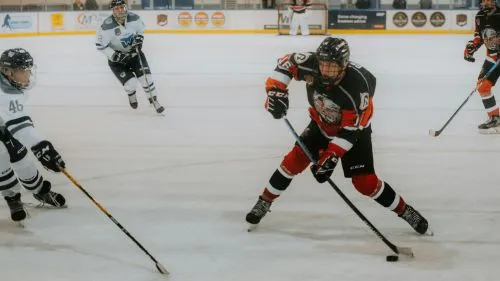
Holding yourself back during games is incredibly frustrating because you know how well you can play. This has nothing to do with physical talent, especially if you are playing well during practices.
-
You are aggressive during practices.
-
You trust your skills during practices.
-
You feel free when there is less pressure.
Something changes during games.
What changes is the amount of pressure you feel, and more importantly, how that pressure causes you to think.
In this article, I want to help you understand why athletes hold themselves back, so you can understand yourself better and begin playing more freely and more aggressively in competition.
What Is the Main Reason Athletes Hold Themselves Back?
The simplest way to explain why athletes hold themselves back is this: on some level, fear is driving your play.
When we are afraid of anything, the brain shifts into a protective mode—that protection mode results in hesitation, caution, and holding ourselves back.
Several specific fears commonly drive this behavior.
Why Fear of Making Mistakes Causes Athletes to Play It Safe
The most common fear I see in my work with athletes is the fear of mistakes.
When athletes are afraid of mistakes, the thinking becomes:
-
“I need to avoid mistakes at all costs.”
-
“If I make a mistake, it’s going to be the end of the world.”
-
“I might get benched.”
-
“People might think I’m not a good player.”
I recently spoke with a hockey player about this exact issue. He explained that when he holds himself back, the thinking is simple:
“If I don’t try, I can’t make a mistake.”
This mindset creates frustration for:
-
The athlete
-
The parents
-
The coaches
Everyone wants effort, but fear of mistakes prevents it.
When mistakes are seen as purely negative, athletes subconsciously reduce involvement. By playing less aggressively, they reduce the risk of making mistakes.
That is why athletes describe feeling like:
-
They are hiding.
-
They are playing with their foot on the brake.
Holding yourself back becomes a form of self-protection.
How Physical and Psychological Intimidation Affects Performance
Another major reason athletes hold themselves back is intimidation, which often overlaps with fear of injury.
I work with a football player who experiences this consistently. During the offseason, we have focused on building confidence and reducing his fear of opponents and physical contact.
When he lines up against a bigger player:
-
He hesitates
-
He stutter-steps
-
He delays engaging in the play
That hesitation is a clear form of holding yourself back.
This shows up across many sports:
-
Basketball: avoiding driving to the basket or posting up
-
Soccer: avoiding one-on-one situations
-
Hockey: pulling out of physical play
-
Baseball/Softball: being intimidated by pitch speed and fearing getting hit
In these situations, athletes play it safe to protect themselves.
Intimidation is not always physical.
Psychological intimidation happens when:
-
Teammates talk about how good the other team is.
-
Coaches mention past losses.
-
You hear that the opponent is “really tough to beat.”
Before the game even starts, fear of losing sets in.
Athletes enter the competition already intimidated, already cautious, and already holding themselves back.
I have also worked with skiers who were intimidated by the difficulty of a trick. They avoided it altogether, which again ties into their fear of injury and failure.
Why Some Athletes Hold Themselves Back When They are Capable of Winning
Fear of success is one of the most overlooked reasons athletes hold themselves back.
It is often deeper and harder to identify than the fear of mistakes.
I experienced this myself as a younger athlete. My fear of success was tied to social anxiety.
-
I did not want postgame interviews.
-
I did not want attention at showcases.
-
I did not want to stand out.
So I subconsciously self-sabotaged. Holding myself back felt safer than dealing with the discomfort success might bring.
I currently work with an equestrian athlete who experiences fear of success in a different way. She has been in a toxic environment and does not see herself as deserving of success. She fears ridicule if she puts herself out there.
As a result, she holds herself back.
Fear of success can involve:
-
Identity
-
Environment
-
Self-worth
And it can be just as powerful as fear of failure.
How Focusing on Results Holds Athletes Back
Another reason athletes hold themselves back is when the mind becomes too focused on results.
-
What will happen if I mess up?
-
What does this mean for my future?
-
What if I fail?
Attention shifts away from what is happening right now and onto outcomes.
When the mind is locked on results, fear increases and freedom decreases.
How to Stop Holding Yourself Back and Play Freely
Understanding why you hold yourself back is the first step.
The next step is acknowledging what is happening without using it as an excuse.
This is not about saying you have no power. It is about identifying:
-
Patterns of thinking
-
Types of focus
-
Mental habits during competition
From there, you can begin asking better questions:
-
Is this something I actually need to be intimidated by?
-
Is playing to avoid mistakes really protecting me?
-
Or is it making things worse?
These questions open the door to change.
Working Through Holding Yourself Back
If you are currently holding yourself back and want to work toward playing freely, this is something I focus on extensively in my one-on-one mental performance coaching program.
If you’re interested in learning more about my one-on-one mental coaching program, click here to schedule a free introductory coaching call, or fill out the form below.
I’ve also created two online mental training courses for athletes:
And if you’re more of a reader, check out my books:
Thank you for reading, and I wish you the best of success in all that you do.