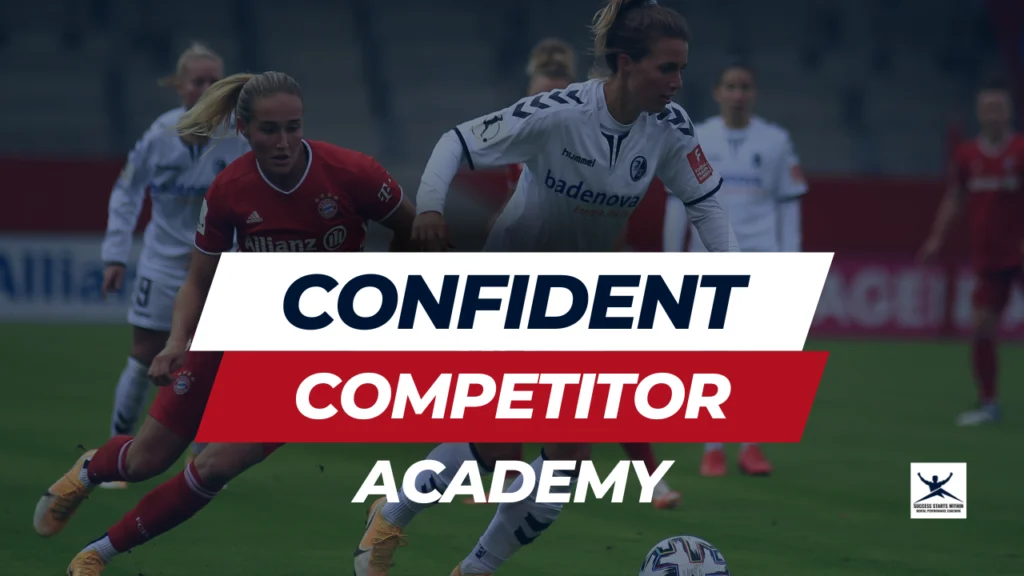

If you are underperforming in games but not in practice, you may be wondering whether you need more reps or mental performance coaching.
Before deciding whether you need a mental performance coach, you must answer one key question: Does your performance change when pressure increases?
If your mechanics break down, confidence disappears, or anxiety spikes only during games — but not during practice — the issue is likely mental, not physical.
Practice builds skill. Mental training builds the ability to trust that skill under pressure.
If you perform well in practice but struggle in competition, that gap is not solved by more repetitions alone.
Do I Need a Mental Performance Coach or Just More Practice?
This is one of the most common questions athletes and parents ask.
If you are underperforming in games but not practice, you may be wondering whether you simply need more repetitions or whether something mental is holding you back.
You likely need more practice if:
-
Your mechanics are still developing
-
You are new to the sport
-
Your performance is inconsistent everywhere — in both practice and games
-
Improvement clearly follows repetition
You may need a mental performance coach if:
-
You perform well in practice but not in games
-
Pressure changes how you think or move
-
Anxiety affects your mechanics
-
You overthink during competition
-
One mistake ruins the rest of your performance
The key distinction is not effort.
It’s whether pressure is changing your performance.
Watch: Do You Need More Practice, or Mental Coaching?
When it comes to improving your skills, for most of us our minds immediately turn towards physical training. The same holds true for when you’re struggling. Spending extra hours refining mechanics seems like the best option.
While physical training is a key component of peak performance, it is not the only factor. In fact, thinking this way may be limiting you and keeping you from unlocking your true potential.
In addition to physical training, athletes and performers will greatly benefit from mental training. Working hard to build mental skills such as confidence, focus, resilience, and many others that will add an additional element to the physical skills they already possess.
Since physical training is the mainstream approach; there isn’t really a question as to when it should be used. Everyone knows that if you want to improve, you must work on your physical skills.
However, when it comes to mental skills and sport psychology, many athletes and performers question when is the right time to turn their attention to this other form of training?
What Does a Mental Performance Coach Help With?
A mental performance coach helps athletes strengthen confidence, focus, resilience, and composure under pressure.
The goal is not to rebuild mechanics. It is to strengthen how you think and respond when pressure increases.
If your physical skills are inconsistent everywhere — in both practice and games — more repetition is likely the answer.
But if your skills are solid in practice and break down only during competition, the issue is usually mental performance under pressure.
Understanding this difference prevents you from chasing physical fixes for mental challenges.
If you would like a full breakdown of how structured mental performance coaching works, read my complete guide here: What Does a Mental Coach Do?
A Reactive Approach to Mental Coaching
The first approach to sport psychology and mental training is a reactive approach. This is the most common approach, and the one that led me to work with a sport psychology consultant and the one most of the athletes I work with have used.
When you react, you are responding to something. Typically a situation, a form of thought, or a pattern of behavior. In terms of sport psychology, what is it an athlete or performer is reacting to?
They are reacting to struggles within their game.
A reactive approach to mental training happens because you feel as though you are performing below your potential. You know you possess the physical skills to succeed, yet, something is keeping you from performing well in competition.
You may need a mental performance coach if:
- You perform well in practice but struggle in games
- You tighten up under pressure
- You overthink mechanics during competition
- One mistake ruins the rest of your performance
- Fear of failure causes you to play cautiously
- Anxiety affects your mechanics (such as the yips)
- Confidence swings dramatically based on recent results
When these patterns appear consistently, more practice often increases frustration rather than solving the root issue.
Signs You Need a Mental Performance Coach
If these patterns show up consistently, it is a sign that the issue is not physical preparation but mental performance consistency.
Athletes who need mental performance coaching often say things like:
- “I play great in practice but freeze in games.”
- “I know I have the skills, but I can’t trust them.”
- “I tighten up when the pressure increases.”
- “I’m working hard, but nothing changes.”
When practice performance does not transfer into competition, the gap is usually mental, not mechanical.
Top Mental Game Challenges Faced By Athletes & Performers
The areas keeping you from performing your best are known as mental game challenges. Every person is different and the situation they’re in is unique. However, at the core, there is a group of common mental game challenges that are often to blame for performing below your potential.
The top mental game challenges faced by athletes and performers include:
- Performance Anxiety: when you’re overly worried about what may or may not happen you develop performance anxiety. With this mental game challenge, thoughts race through your mind before and during a performance. They are centered around trying to control the outcome. More specifically, seeking to keep a negative outcome from happening.
- Fear of Failure: failures and mistakes are common in sports, as they are in life. When you start to fear making mistakes, you form fear of failure. Fearful of making a mistake, this leads to playing timidly and tense.
- Perfectionism: this occurs when you feel a deep need to be perfect. Instead of seeing yourself as a continual work in progress, you seek perfection. What’s worse is, perfectionists tend to never feel perfect and get caught in a perpetual cycle of always feeling as though they’ve failed.
- Self-Doubt: confidence is the cornerstone of greatness. You must have a belief within yourself that you can succeed. Though, when you doubt yourself such belief vanishes. Self-doubt leads to second guessing, freezing during competition, and holds you back from performing freely.
- Poor Focus: during competition, distractions are everywhere. To keep your mind focused, you need to have the strength to control your attention. Lacking such strength will result in poor focus that is impacted by the many distractions which are present.
- Loss Of Motivation: whether due to failing, losing the passion to play, anxiety, or any other cause, a lack of motivation will negatively impact you. You need motivation to push through adversities and train hard. When it’s absent, you will be falling short of the potential you are capable of reaching.
- Social Approval: desiring positive feedback is one thing, but needing the approval of others as a way to boost your own confidence and self-worth is dangerous. This leads to fear of failure and anxiety since performing poorly will result in you losing the approval you so desperately need.
Each one of these mental game challenges will have a negative impact on performance. They are the main driving factors behind an athlete or performer seeking sport psychology help.
These challenges are worked through using sport psychology and mental training tools. A mental performance coach helps you identify what’s actually happening mentally, and then trains the specific skills needed to perform freely under pressure.
To see exactly how the structured process works, read more about how mental performance coaching works.
But you don’t need to wait until one of these challenges wreaks havoc on your performance. Instead you can use mental training in a different, more proactive way.
“A reactive approach to mental training happens because you feel as though you are performing below your potential. You know you possess the physical skills to succeed, yet, something is keeping you from performing well in competition.”
A Proactive Approach to Mental Coaching
Proactive mental training is what separates good athletes from elite competitors.
The best athletes in the world do not wait for confidence problems to appear. They train their mindset the same way they train their body.
Just as strength training prevents injury and improves performance, mental training prevents performance breakdowns and improves consistency.
When you take a proactive approach this means you are seeking to cause something to happen rather than responding to it afterwards. With a proactive approach, you aren’t waiting for your performances to turn bad in order to utilize a mental performance coach.
With a reactive approach as outlined above, you respond to feelings of self-doubt, anxiety, fear of failure, or any other mental game challenge you notice is keeping you from performing your best.
Now, instead of waiting for those to happen, you recognize the possibility of them and also the benefits mental training will have on your game, and proactively seek the help of a mental performance coach.
This approach is much more aligned with traditional training on the physical side.
Athletes don’t tend to wait for their performance levels to drop before they begin weight training or working on their skills. From a young age, training mechanics and working on the fundamentals of their sport has been impressed upon them.
There is an understanding that if you want to reach higher levels, more and more training must be put forth. A proactive approach to mental training simply adds working on your mental game to this formula.
By taking a proactive approach to sport psychology, you aren’t so much seeking to overcome mental game challenges as you are desiring the many benefits mental training has to offer. Some of the main benefits you can expect include:
- Increased Confidence: one of the major benefits is an increase in your confidence. No matter what you do, there needs to be an underlying belief within yourself that you are capable of success. Mental performance coaching can provide you with such belief.
- Improved Focus: during a game, with the many distractions present, you must be able to focus. Through mental performance coaching, you will learn mindfulness. A powerful technique to train focus and strengthen your ability to concentrate.
- More Resilience: setbacks and failures can be expected in sports. It’s not really whether or not you experience them that matters, but how you respond to them. By strengthening your mind, you will gain a greater ability to be resilient in the face of adversity.
- Decreased Anxiety: being able to calm your mind before competition is a huge advantage. In doing so, you center your attention in the present moment and reduce many of the anxious thoughts that typically fill your mind.
- Increased Motivation: whether it’s motivation to compete or train, mental coaching will help you uncover what it is that drives you. By approaching each day with true motivation, you will be more focused and bring more intent to all that you do.
- Positive Self-Talk: the cornerstone of emotions and behavior is thought. If the voice in your head is negative, the emotions you experience will mirror that. However, by taking control of your thoughts through instilling positive self-talk, you will gain more confidence and find more joy in performing.
“By taking a proactive approach to sport psychology, you aren’t so much seeking to overcome mental game challenges as you are desiring the many benefits mental training has to offer.”
Final Thoughts
In addition to training your physical skills, there is another element you need to add to your plan. That element is mental training.
Through the use of sport psychology and mental training tools, many positive benefits will be experienced, all helping to take your game to the next level.
When it comes to using a mental performance coach, there are two approaches you can take. There’s the reactive approach and a proactive approach. But no matter which approach fits you, mental performance coaching will be a valuable addition to your game.
Inside my structured 12-week mental performance coaching program, you will:
- Complete a detailed mental performance assessment
- Receive a personalized mental training plan
- Meet with me weekly for focused 30-minute coaching sessions
- Apply targeted exercises between sessions
- Receive ongoing support as you implement the tools
If you are ready to strengthen your mental game and perform freely under pressure, click here to learn more about the 12-week mental performance coaching program.
Thank you for reading and I wish you the best of success in all that you do.