
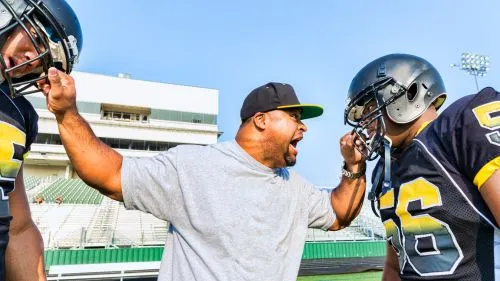
No athlete likes to get yelled at. It’s not fun when you’re in practice or a game and your coach yells at you. This can make you feel insecure, timid, and can even lead to more fear about being yelled at in the future.
But as an athlete, you know you need to be able to take this feedback and criticism from coach in a productive way—or at least in as productive of a way as possible.
In today’s post, we’re going to talk about how to receive feedback specifically in the form of yelling from your coach, whether it’s during practice or a game.
Why Coach Yelling Can Hurt Your Mental Game
A key part of a strong mental game is being able to remain in the mindset you want to have throughout an entire competition. That means no matter what happens, nothing can pull you out of that confident, aggressive mindset that helps you play your best.
One of the most common challenges that can pull you away from this mentality is coach yelling.
This is something we need to work on. In fact, I was just talking with an athlete this morning about this very topic.
He’s a basketball player, and his coach yells at him a lot during practices and games. But he and his coach also have a very strong relationship.
It’s not that his coach doesn’t like him—in fact, it’s the opposite. His coach yells because he believes in him. He’s trying to push him, to motivate him, and to bring more out of him.
In this case, his coach is trying to get more intensity and aggressiveness from him on the defensive side of the ball.
But for this athlete, the yelling doesn’t motivate—it creates fear. It makes him more afraid of future criticism. He ends up playing timid and scared, holding himself back as a result.
That’s not what his coach wants. And this is something I’ve seen in a lot of athletes across different sports.
Take What Coach Says, Not How Coach Says It
What I told this athlete—and what I want to share with you—is something you’ve probably heard before: take what coach says, not how coach says it.
But in order to do that, you have to first believe that your coach is trying to help you.
I know from personal experience that this isn’t always easy. When I was playing, I wasn’t great at taking yelling or feedback. I always thought it meant my coach was mad at me or didn’t like me.
Now, after working with hundreds of athletes, I’ve learned to see this differently—and I’ve helped athletes handle yelling in a much more positive way.
It’s just like when you get criticism from your parents. You want to go into the situation knowing they’re there to help you. The same goes for your coach.
Coach wants you to be the best you can be—because when you perform your best, the team performs its best.
It doesn’t always feel that way, and it’s not always delivered in the best tone. But you can’t control that. You can only control how you respond.
So instead of wishing your coach communicated differently, learn to handle feedback differently.
From Emotional Reaction to Objective Response
If you start with the mindset that coach is trying to help you, it becomes easier to take what they say and not how they say it.
Last week, this same basketball player and I were working on setting controllable objectives—things he can focus on during games to keep him present.
Often, his mind is all over the place—on coach, on what others think, or on whether he’ll make a mistake. So we’ve been working on being present, which is one of the most powerful mental skills an athlete can develop.
But when coach yells, he forgets his objectives. His mind shifts to fear and worry.
As we talked today, we realized something important: coach was actually giving him objectives to focus on—but he couldn’t see them because he got too emotional about the way they were delivered.
That’s the key difference between an emotional reaction and an objective response.
When you react emotionally, you feel fear, frustration, and self-doubt. When you respond objectively, you focus on what’s being said—“Coach wants me to give more effort on defense”—instead of how it’s said.
Turning Feedback Into an Objective
So here’s what I want you to do. The next time your coach yells—whether in practice or during a game—repeat this mantra to yourself:
“Take what coach says, not the way coach says it.”
Then, once you identify what coach said, turn that into an objective.
For example, if coach yells that you need to move your feet faster, your objective becomes, “Move my feet quicker on defense next play.”
Don’t get caught in the spiral of thinking coach is mad at you or might pull you from the game.
Focus on the objective.
That shift—focusing on what you can control—is how you stay mentally tough and composed, even when emotions run high.
Final Thoughts
Taking feedback—especially in the form of yelling—isn’t easy. But if you want to strengthen your mental game, it’s something you need to master.
You can’t control how coach delivers information, but you can control how you take it.
Start by reminding yourself that your coach wants to help you improve. Then, use the mantra: Take what coach says, not how coach says it.
Finally, turn that message into a clear, controllable objective for your next play, pitch, or rep.
If you practice this, you’ll learn to stay composed, confident, and focused—no matter how loudly coach is yelling.
If you’re interested in learning more about my one-on-one mental coaching program, click here to schedule a free introductory coaching call, or fill out the form below.
I’ve also created two online mental training courses for athletes:
And if you’re more of a reader, check out my books:
Thank you for reading and I wish you the best of success in all that you do.