
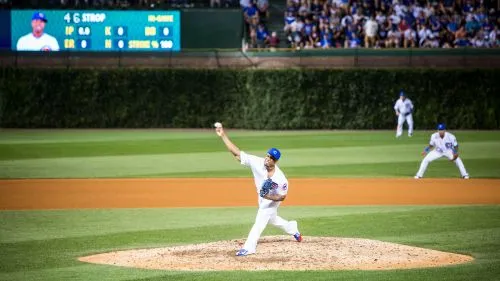
To deal with an embarrassing game, the key is learning how to process it differently.
Instead of dwelling on what happened and beating yourself up, you need a system to move on from what happened.
If not, there’s a strong chance the embarrassing game will leave an imprint on your subconscious mind, leading to fear and anxiety moving forward.
But if you’re able to process it well, you can leave the embarrassing game in the past, where it belongs.
What Embarrassing Games Look Like
I’m sure you can think back to some embarrassing games you’ve played. Maybe it was even your most recent game. These are games we wish had never even happened.
I can remember some of my most embarrassing games as clearly as if they had happened yesterday. One was a game in high school where I was moved from second base to shortstop because our senior shortstop went into pitch.
I was excited and terrified. I was a sophomore, ready to prove myself at the position I hoped to earn the following year.
Unfortunately, the game didn’t go as expected. I made a bunch of errors, and after the game, my coach screamed at me during the post-game talk.
Many of the athletes I work with in one-on-one coaching have similar stories.
The truth is, sports are full of embarrassing moments. And if we don’t know how to handle them, they can have a negative impact on our mindset and performance moving forward.
What Happens When You Respond Poorly to Embarrassing Games
How we respond to games impacts our future mindset.
Think of it like this: two athletes have equally embarrassing games. One processes it well while the other criticizes themselves and does not respond well.
The one who processes the game in a constructive way plays without fear in their next game. While the one who responds poorly worries about having another embarrassing game.
Both experienced the same level of embarrassment, but they did not equally experience the same level of fear and anxiety moving forward.
The difference was not the level of embarrassment felt, but rather the response each had to the embarrassing game.
When we don’t respond well, this increases our chances of developing fear of failure or sports performance anxiety.
We fear experiencing a similar embarrassing game and grow anxious about doing so.
Unfortunately, playing with fear and anxiety increases the chances of playing poorly. Thus forming a vicious cycle.
The Yips
In extreme cases, embarrassing games can result in athletes developing the yips. The yips are a psychological phenomenon where an athlete can no longer perform a simple action.
Some examples of the yips include:
- Catchers unable to throw the ball back to the pitcher
- Golfers unable to sink easy two to three-foot putts.
- Basketball players unable to shoot free throws.
Simple actions that, due to intense levels of fear and anxiety, have become difficult for the athlete to perform.
Embarrassing games leave an imprint on the subconscious mind. This changes how the mind reacts in these moments, resulting in the yips taking over.
All of the athletes I’ve worked with who struggle with the yips have either experienced an injury or an embarrassing moment at the onset.
Just another reason why we need to focus on how we respond to embarrassing games!
Strategy to Deal With an Embarrassing Game
I first want to say that we are not trying to pretend like the game was not embarrassing, or trying to get you to convince yourself that you don’t care about what happened.
That is an unrealistic approach.
Instead, we are working to get you to process through what occurred in a healthier way.
This involves a four-step process.
Step 1: Give Yourself Some Time
Instead of diving right into evaluating the game, it’s wise to give yourself some time to cool down.
This could be for the entire car or bus ride home, or the rest of the day.
What this does is allow the initial emotions you experienced to wear off. Because remember, our goal is to deal with the game in a way that sets you up for success moving forward.
NOT make the game that happened less embarrassing.
What we must be careful of is you beating yourself up initially after the game. That is dangerous.
So give yourself some time and take your mind off the game for an hour or so, or even the rest of the day.
Step 2: Write Down Some Positives
Once you’ve given yourself some time, it’s now the point where we need to evaluate what happened.
To think through the game productively.
Which first involves you writing down the positives.
But what if there aren’t any positives?
I thought you’d ask that. You are going to need to look hard, but I guarantee there was something good you did. Even if it was simply cheering on your teammates.
This is a critical step because we are trying to neutralize the game and not make it such a one-sided, embarrassing game.
The embarrassment is still there, but you’re working to see that there were also some good elements to the game.
Step 3: Process What Happened
This third step is really where we work through the embarrassment.
The reason talk therapy and other forms of therapy work is that they allow the brain to process traumatic experiences in a safe way. Doing so reduces the emotional attachment and the subconscious impact the memory or experience has on your life.
What you want to do is write down what happened in the game. Just go back through each moment that was embarrassing.
This won’t be fun, but it will be effective.
While you’re doing so, try to also write down lessons you can take away from your mistakes.
You may need to go through step three multiple times over multiple days to truly allow your brain to process what happened.
Step 4: Accept, Forgive, and Move On
Once you’ve processed the game, it’s time to forgive yourself for having performed poorly.
This is a crucial step.
We tend to think we need to beat ourselves up to keep ourselves from playing poorly again. But you know you did badly, and criticizing yourself will only make things worse for you in the future.
It’s now time to accept that the embarrassing game happened, forgive yourself, and move on.
The moving on part is aided by you having identified lessons in step three. You can move on by focusing on the improvements you need to make during practice or your next game.
But dwelling on what happened will only hold you back and will only lead to more fear and anxiety moving forward.
Causing more embarrassing games to happen.
Final Thoughts
Embarrassing games happen to all athletes. You make that critical mistake or mess up in a big moment, and then you barely want to show your face at practice the next day.
But it’s not the game itself that is the most dangerous, but rather the effect it has on your mind moving forward.
To keep fear and anxiety (and even the yips!) from forming, follow the strategy outlined above for dealing with embarrassing games.
But if you want an even more personalized way of handling these games, this is exactly what I help athletes do in my one-on-one mental performance coaching program.
Click here to learn more about one-on-one coaching to see if it’s a good fit.
Thank you for reading, and I wish you the best of success in all that you do.